Case study / 02Toyota · Design Systems

Ellipse, Toyota's Design System.

Role
Led the rebuild: architecture, governance, adoption
Team
Design team, engineering, product
Platform
Web, app, dealers, in-car screens
Outcome
An enterprise design system used across all of Toyota's digital ecosystem
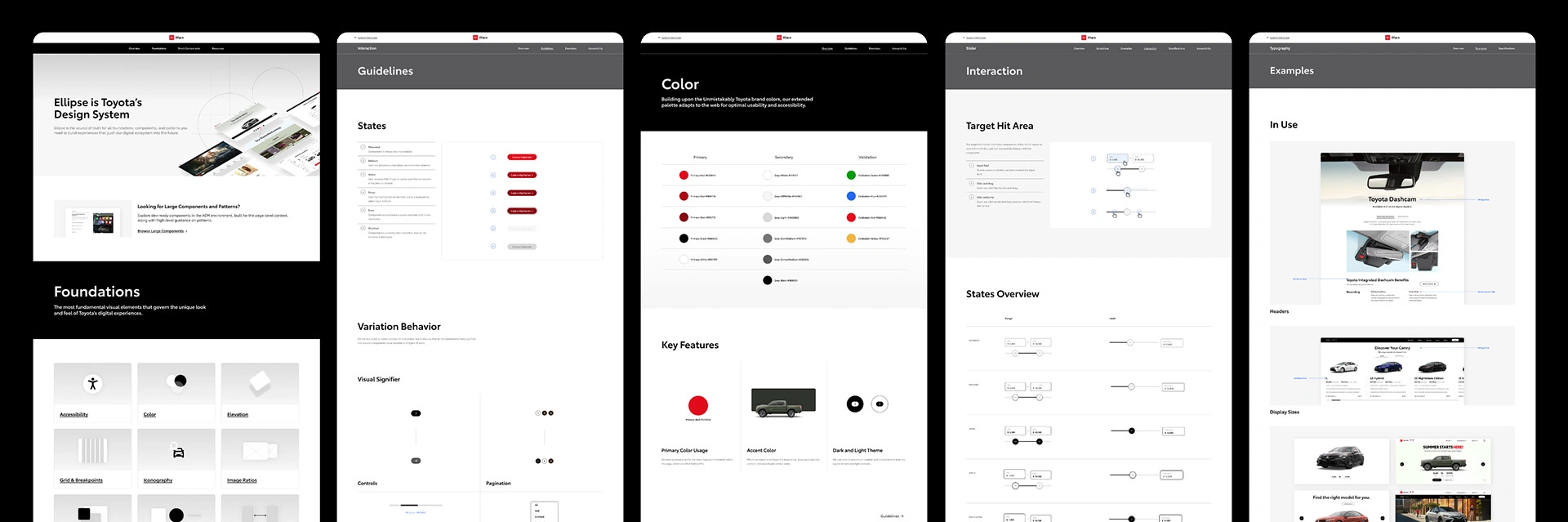
Ellipse component library overview
The challenge

The system existed. It just couldn't keep up with Toyota.

When I joined, Ellipse was already in place, but it was a component library, not a foundation. Components were built for single use cases. Layouts that looked nearly identical existed as separate components. Atomic design in name, rigid in practice.

As Toyota's digital ecosystem expanded across web, dealer tools, and in-car, that rigidity became the bottleneck. The system needed to support multiple teams, platforms, and business initiatives without fragmenting the experience.

The approach

Three moves that mattered
01

Rebuild the architecture

We broke components into smaller, reusable building blocks that compose into a wide range of layouts. More flexibility, less redundancy, and teams that move faster without drifting apart.

02

Ship a core, not a migration

Rather than rebuild everything at once, we shipped a focused set of core components first. Teams got value early, and adoption compounded instead of stalling on a long migration.

03

Make governance real

I established the governance model and strengthened the design-engineering partnership: clear ownership, streamlined handoffs, formal documentation. Shared accountability instead of tribal knowledge.

The outcome

A component library became the foundation Toyota's ecosystem runs on.

The modular rebuild changed what the system could support: one set of building blocks serving Toyota.com, dealer tools, and in-car experiences, with governance that keeps it coherent as it scales across teams.

It's also the prerequisite for the AI work. The Figma MCP plugin generates layouts from Ellipse components, and that only works because the architecture is built from composable pieces. Rigid, single-use components can't be composed intelligently by an AI layer. These can.

20%
Reduction in designer and developer maintenance time
Modular
Composable blocks, not frozen templates
AI-ready
The foundation the MCP plugin runs on